


A BOOK ON THE BLOODY HISTORY OF THE FRANCISCAN PROVINCE OF HERZEGOVINA IN WORLD WAR II AND ITS AFTERMATH AND COMMUNIST CRIMES HAS BEEN PUBLISHED
Published by the Zagreb house Despot infinitus d.o.o. the book “Herzegovinian Franciscan Province during and after the Second World War” by Dr. sc. Hrvoje Mandić was published. The book was published as an extended doctoral dissertation that was translated into English, after its Croatian edition was published in 2021 under the title “The Franciscan Province of Herzegovina in the Second World War and the Aftermath”. In Croatian historiography, until this book, a complete synthesis of the Franciscan Province of Herzegovina in the Second World War and its aftermath has never been published, although a quality research foundation has been laid, especially in Bosnia and Herzegovina, which can be used for studying the history of the Franciscan Province of Herzegovina in the period from 1941 to 1945.
The book is based on deep and comprehensive research over a number of years through all available documentation and other testimonies and is of exceptional importance for the circumstances of the murders of the Franciscans on Široki Brijeg in February 1945. The book exposes the propaganda that subsequently focused on these and other similar episodes, and which is still repeated in Western historiography as if it were fact. Therefore, it is very important that this book is now also published in English.

The book, however, explores much more than the events themselves, as it places them in a wider context – both the activities of the Herzegovinian Franciscans during the Second World War, the goals of the Communist Party in these areas and the struggle with the Catholic Church. It is, therefore, a great contribution not only to the history of the Franciscans and the history of Bosnia and Herzegovina, but also to the history of the Croats as a nation in general.
One of the reviewers of the book, the famous British historian Ph.D. Robin Harris, wrote that this book is original, significant and that he unreservedly rates it as a book of first-class importance for Croatian history.
FRANJO TUĐMAN – A Political Biography: Partisan, General, Historian, Dissident and First President of Croatia

Franjo Tuđman usually has been portrayed as a Croatian nationalist and an authoritarian leader who conspired with Slobodan Milošević to destroy Yugoslavia in 1991, but Sadkovich describes a complex and ambitious individual who began life in a small town in the Croatian Zagorje, discovered Marxism as a student in Zagreb, fled to the mountains to join the artisans, then moved to the Yugoslav capital of Belgrade, where he began to write history and became the youngest general in the Yugoslav army before returning to Zagreb in in 1961 as a historian to direct the newly created Institute for the History of the Workers’ Movement in Croatia. It was as a historian that he challenged the regime’s version of history and broke with the League of Communists and joined the movement for reform known as the Croatian Spring. By 1973, he had become a dissident, by 1984, a nationalist imprisoned for his writings, by 1989, of the Croatian Democratic Union, and by 1990, president of Croatia.
In the first eight chapters, Sadkovich discusses Tuđman’s intellectual and political evolution through 1989 and the role played by his interest in history, which reinforced his identity as a Croatian intellectual and provided him with the “objective realities” and “historical truths” he needed to challenge those who supported the Party’s version of Yugoslavia’s history. The final chapter offers “tentative answers” to questions regarding Tuđman’s tenure as president of Croatia during the Yugoslav wars of succession. He was often misunderstood because he spoke like a historian when he should have acted the statesman, and his defense of Croatia’s people, culture, and reputation seemed to many to be aggressively nationalist. But Sadkovich argues that rather than an authoritarian nationalist intent on creating a “greater Croatia,” Tuđman was a patriot who believed that, as a “small nation,” Croatia needed to be independent to preserve its identity, and that, if it was to survive, it had to join and support organizations like the European Union and the United Nations.
AUSTRO-HUNGARIAN MINE WARFARE AND AUXILIARY VESSELS IN WORLD WAR ONE

About the book
Beside fighting ships, all navies of the world have a number of auxiliary warships in their inventory, and the Austro-Hungarian Imperial and Royal navy was no exception. In addition to the ships specially built for various purposes (repair ships, mother ships for torpedo boats and submarines, rescue ships, tugboats and yachts), a number of merchant ships were hired or requisitioned during the war to serve as auxiliaries for transport of personnel and material, as patrol and anti-submarine ships, gunboats or hospital ships. This book is dedicated to all these larger and smaller steamers, and to the mine warfare ships – minelayers and minesweepers – as well, whose actions were often forgotten, as the final book in the series on Austro-Hungarian warships in the First World War.
In addition to the technical and historical data and ships´ fates after the First World War, the book also contains a number of photographs and drawings of most of the listed mine warfare, auxiliary, transport and hospital ships.
THE AUSTRO-HUNGARIAN DANUBE FLOTILLA IN WORLD WAR ONE

Austria-Hungary was also known as the Danube Monarchy because the Danube River, as an important transport route, connected several lands of the monarchy with each other and with the Black Sea as well. The river served at the same time as a frontier with some less stable neighbors, and during the presence of Turkey on the Balkans, the Austrian Empire had at its disposal a strong Danube flotilla with sail- and rudder-driven warships. In the second half of the 19th century, there began the building of a Imperial and Royal Danube Flotilla equipped with steam-driven warships. During the World War One, Austria-Hungary operated ten monitors on the Danube, together with a score of patrol boats, armed steamers, and auxiliary warships. The history and fates of all these vessels are given here, together with the history of their development, with technical data and numerous illustrations, supplemented by an extensive list of sources and literature, to enable the search for further details.
THE OTTOMANS – Rise and fall 1299 – 1922

The Ottoman Empire was one of history’s largest and longest-lasting empires. It was founded around the end of the 13th and lasted for about six centuries. The empire was created by Turkish tribes based in Anatolia (today part of Turkey) and increased in size over the centuries. At its zenith, the Ottoman Empire included most of southeastern Europe, parts of the Middle East, North Africa all the way to Algeria, and portions of the Arabian Peninsula. The Ottoman Empire is named after Osman I (known also as Osman Gazi), who is credited with the establishment of the empire. Although Osman is a key figure in the history of the Ottoman Empire, little is known for certain about his life. He is believed to have been born around the middle of the 13th century and belonged to the Kayi branch of the Oghuz Turkmen. His father, Ertugrul, had established a principality in Sogut (in the northwestern part of modern Turkey), and was in conflict with the Byzantines to the west. Osman is said to have succeeded his father at the age of 23 and continued the fight against the Byzantines. Around 1300, Osman declared himself the supreme leader of Asia Minor, thereby founding the Ottoman Empire. While Ottoman tradition claims that Osman died in 1326, after the capture of Bursa, others have argued that he died in 1324, when his son, Orhan, ascended the throne.
Knjigu možete naručti OVDJE.
AUSTRO-HUNGARIAN TORPEDO BOATS IN WORLD WAR ONE

Torpedo was invented as a revolutionary weapon in the then Austro-Hungarian Rijeka/Fiume, and it is no wonder that the Austro-Hungarian Navy commissioned early its first steam torpedo boats, to defend the coast from attacks by an enemy fleet or its own naval forces from attacking enemy torpedo boats. Between 1875 and 1916, a total of 132 A-H torpedo boats were commissioned, and during the World War One, 51 new larger boats operated together with 12 smaller within torpedo flotillas or for local defence, with scores of older boats serving as minesweepers or in other secondary roles. The „fleet torpedo boats“ were almost never used in their initially envisaged role, as the battle fleet of both sides were rarely leaving harbor. Thus the A-H torpedo boats were operating together with destroyers and fast light cruisers, attacking targets on the enemy coast, chasing submarines, supporting air attacks or searching for mines. From over 200 torpedoes carried on 63 operational torpedo boats, only ten were launched during combat and from these only five hit the targets. All A-H torpedo boats survived the war, to be distributed among the victorious navies, with several remaining on the Adriatic, to serve with the small Royal Yugoslav Navy. In addition to the boats that entered service, their technical data, service and fates, many unrealized projects of steam and motor torpedo boats are described in this richly illustrated book as well.
AUSTRO-HUNGARIAN DESTROYERS IN WORLD WAR ONE

The Austro-Hungarian destroyers were during the World War One almost daily at sea, together with the scout cruisers and torpedo boats, to accomplish various tasks, beginning with the anti-submarine warfare, over mine sweeping and laying, to the attacks on the enemy maritime communications or on the Otranto Barrage vessels. The served often to receive A-H seaplanes returning from their missions against the enemy coast as well, to help the machines after an emergency landing on sea, and to tow them back to harbor or to rescue their crews.
This richly illustrated book describes all A-H destroyers – called torpedo vessels in the A-H parlance – from the first prototypes to the last unrealized projects. The best and most efficient vessels of the Tátra and Ersatz Triglav classes were equal to destroyers of other navies – French, Italian and British – operating in the Adriatic and could compete with stronger enemies too. Older destroyers of the Huszár class were also very active, together with the much older torpedo gunboats or destroyer predecessors built in the late 19th Century. All these ships are described in detail, with building and tactical & technical data in respective tables, together with the operational history of every A-H destroyer from the commissioning to the end of their service.
SCHNELLBOOTE – GERMAN FAST ATTACK CRAFT 1916 – 2016

The German fast attack craft (Schnellboote, better known during the World War Two under the British designation E-boats) served as a warship category for almost hundred years in five German navies, from the Imperial German Navy (Kaiserliche Marine), over the Reichsmarine and Kriegsmarine, to the Federal German Navy (Bundesmarine) in the western and the People´s Navy (Volksmarine) in the eastern Germany, both established after 1945. The last units of this type were stricken in 2016, to be replaced by corvettes that are to fulfill similar duties in the narrow seas and coastal waters.
The Schnellboote were not often described in detail by the Anglo-American naval authors, and even the origin of the designation E-boats is not completely clear. It is believed that the meaning was “Enemy Boats”, but there were other German vessels belonging to the “boat” category (like the motor minesweepers, called R-Boote by the Germans and R-boats by the Allies, or minesweepers aka M–Boote/M-boats). Thus it is possible that the initial meaning was simply Express Boats, similar to Express Trains (Schnellzüge in German), and later the origin of the name was forgotten.
The book Schnellboote, written by the already well-known naval author Zvonimir Freivogel, is divided into four parts; the first is about the genesis and the development of this warship category in Germany, the second an overview of all S-boat operations on the European war theaters between 1939 and 1945, the third is describing these vessels in the Bundesmarine, and the fourth is a short history of S-boats in the Volksmarine. The book is richly illustrated with over 200 photographs, drawings, and charts, and there are numerous tables with technical and building data, together with fates of all German wartime or post-war fast attack craft.
OUTLINE HISTORY OF THE IMPERIAL JAPANESE NAVY 1868–1945

This “outline” was written with a certain scope in mind and cannot, of course, replace a “history”, of which there are Japanese works with up to 12 and 14 volumes. Readers will therefore undoubtedly notice significant gaps and find descriptions, where too much previous knowledge may have been required, or which are too long or too short. I am solely responsible for these shortcomings and also for errors and misinterpretations for which I apologize and hope for understanding.
Because it can be assumed that the history of the IJN in the 20th Century is better known than its “prehistory” and its structure during the 19th Century, more space has been given to this period and field of subject. Training has also been emphasized since it formed the basis of the structure.
FORTIFICATION SYSTEM OF THE MOST IMPORTANT AUSTRO-HUNGARIAN NAVAL BASE
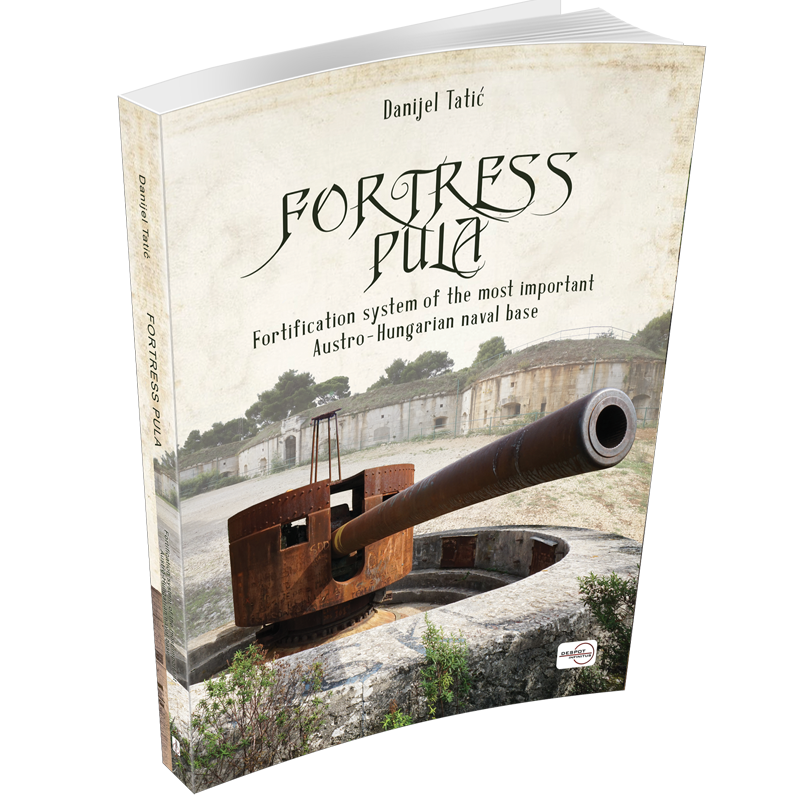
It is no easy task to tell the story of a city created by the military, of its fortifications, and batteries, as well of the powerful arsenal that became the pride of the once glorious Austro-Hungarian monarchy, and yet not bother the reader with details about fortification systems that rack the historians´ brains. There could be much more to add, explain, and write, to show, and to draw, but that is beyond the scope of this book, which was intended as a kind of tourist guide and an attempt to discover all the beauty and complexity of the fortification system of the former Austrian- and later Austro-Hungarian main naval base to the reader as simply as possible. The Pula Fortress consisted of a number of different types of forts and batteries, the majority of which are shown in this book, along with all other fortifications, including those used by the army and by the local population and their guests, coming from all parts of the dual monarchy and from the rest of the world to Pula.
VIS AIRFIELD PLAYED A KEY ROLE IN SAVING THE LIVES OF MORE THAN 4000 ALLIED AIRMAN
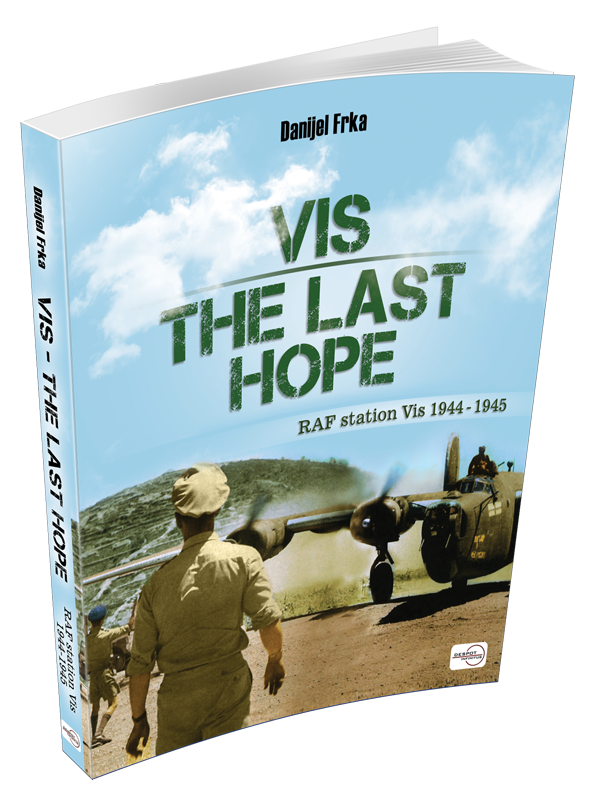
“VIS – THE LAST HOPE” describes in detail the 2nd World War history of the remote Allied airfield on the tiny island of Vis in the middle of the Adriatic sea. By the beginning of 1944, the island of Vis was the only Allied free territory in the middle of Nazi occuied Europe which was defendet by a combined force of Partisan, British and US troops. Vis airfield played a key role in saving the lives of more than 4000 Allied airman whose bombers and fighters, damaged in fierce battles over occupied Europe and unable to reach their bases in southern Italy, came in to emergency land on the short airstrip of Vis. This book tells their story and is a tribute to all those brave men to whom we owe our today’s freedom.
DIVIDED REGIONS, CITIES AND IMMATERIAL ETHNIC MICRO-BORDERS STILL BURDEN LIVED REALITIES AND GEOPOLITICAL VISIONS: MOSTAR, VUKOVAR AND KOSOVSKA MITROVICA
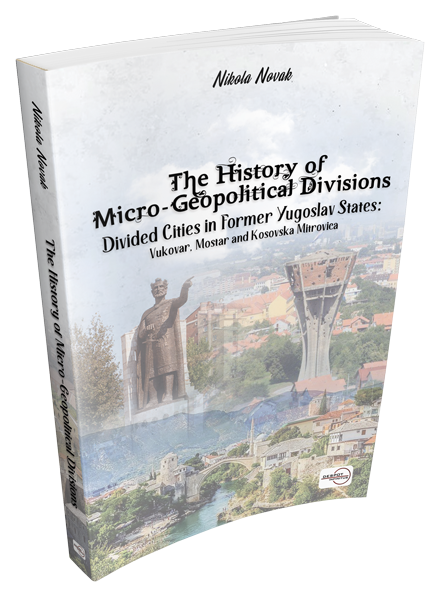
The period after the Great War marked significant geopolitical perturbances in Europe. The collapse of empires, (post)colonialism and the rise of communism and other extremist movements, opposed the liberal understandings of free market, democracy and national self-determination. In Southeastern Europe, the idea of shared South Slavic state brought together nations previously engaged on opposite sides in the War. Battles for political and national dominance, hegemony, clashes of different ideas and constant changes of alliances and internal borders of several shared states led towards further micro-geopolitical divisions in this part of the world. Attempts to make the idea of Yugo-Slavism work fostered the processes of reterritorialization and deterritorialization in the region of former Yugoslavia. The ultimate attempt that sought solutions for Yugoslav nations ended up in wars.
The last armed conflicts that happened in the European continent in the 20th century were the Civil War in Bosnia and Herzegovina, the Croatian Homeland War and the Kosovo War. Even though these states are now independent and internationally recognized countries, post-crisis management had little success. Recognized national borders did not prevent further divisions on local levels and microscale geopolitics. Divided regions, cities and immaterial ethnic micro-borders still burden lived realities and geopolitical visions in this region.
This research is designed as a case study of the micro-geopolitical divisions in the former Yugoslavia with a special focus on divided cities. The primary unit of analysis is microscale entities in the region, but within-case cases are divided cities in states which territories were affected by the Yugoslav Wars – Bosnia and Herzegovina, Croatia and Kosovo. The research combines synchronic and diachronic analysis, as it has historical components and it studies the processes of reterritorialization and deterritorialization in the region – diachronic approach, while, at the same time, it focuses on three similar case studies of the divided cities that were an outcome of those processes – synchronic approach. Those three case studies are Mostar, Vukovar and Kosovska Mitrovica.